
The Ribbon
Part I: Inheritance

I don’t like saying things like happy heavenly birthday. It feels too rehearsed, too detached from the truth of what remains. My mother would have been ninety-one today, April 1, 2026. I’d like to take this opportunity to thank her for teaching me about parenting. I learned by example.
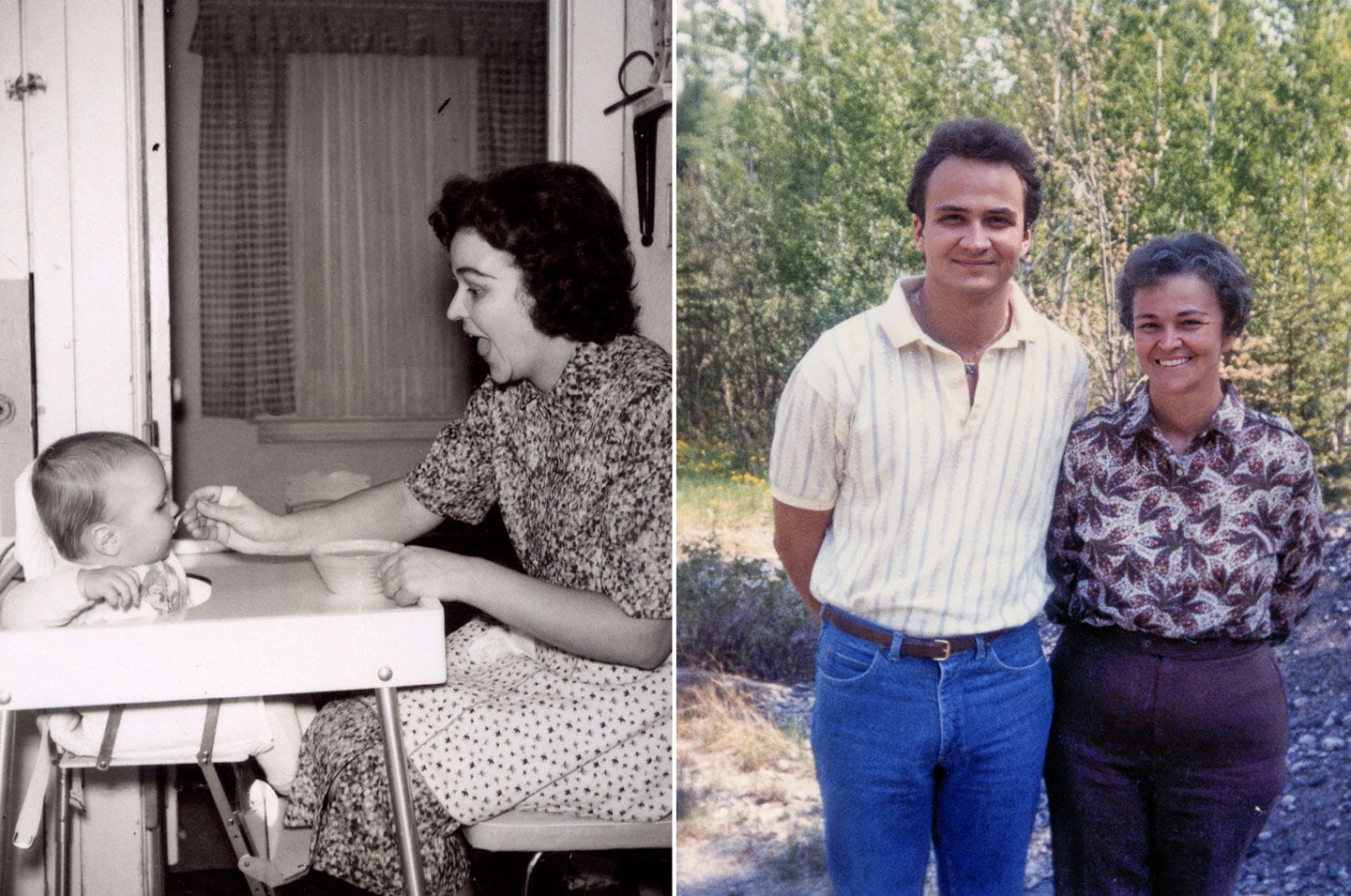
I am my mother’s son. Not only do I exhibit more of her family’s physical traits, but cerebrally and emotionally, we seemed to operate on the same frequency. We often knew what the other was thinking before it was ever spoken. That connection ran so deep because she poured so much of herself into me. It went beyond the duties of care. It shaped a way of seeing the world. I was a mamma’s boy—before either of us had a name for it. What I carry from her is a pattern, a way of being. At times, a steel-like ribbon connected us. Mostly composed of memories, but seemingly indestructible, it now reaches out of her grave.
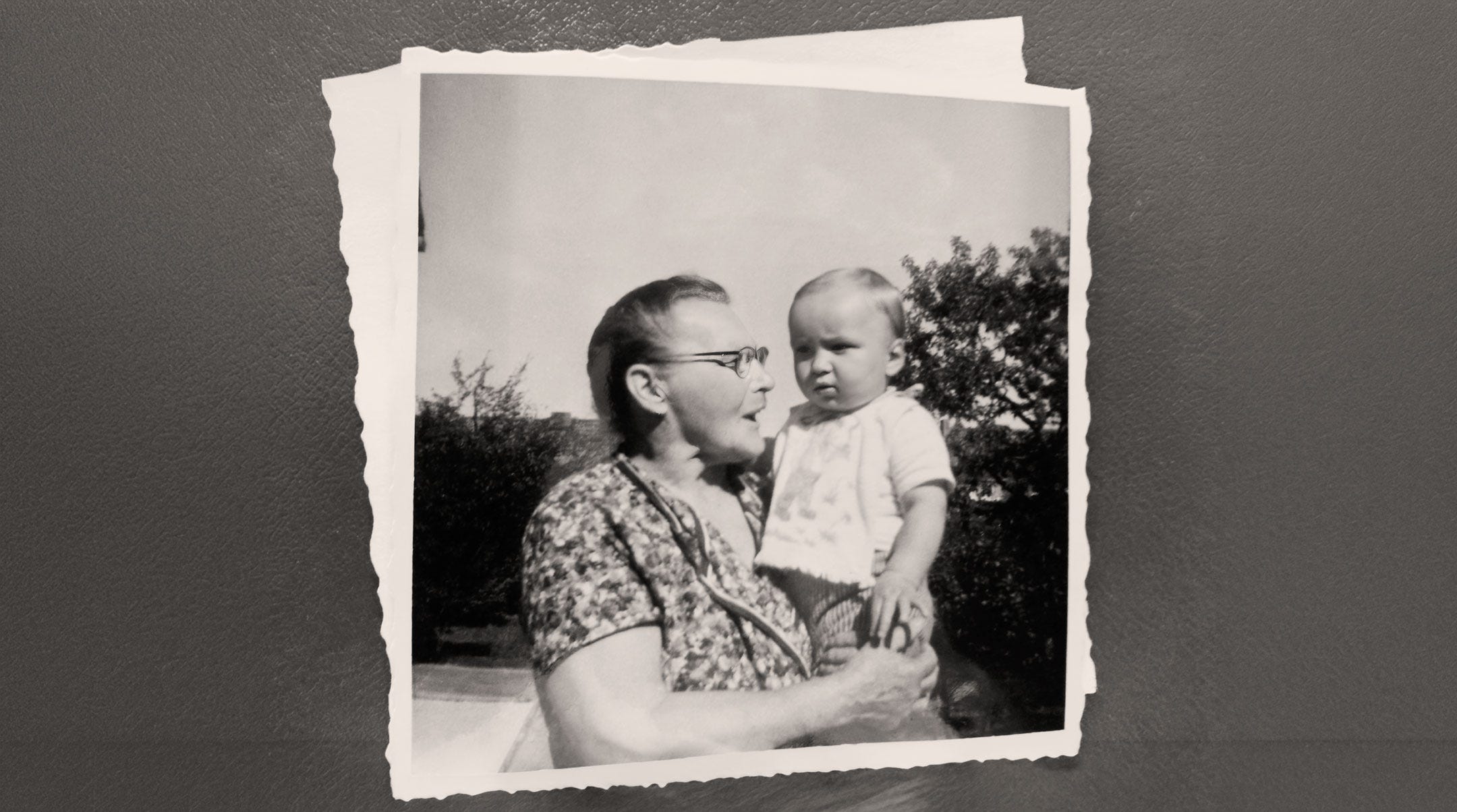
She had that same connection with her grandmother, Theresia Schug, the caretaker of her family in a by gone era. Stalwart and stoic, Theresia ended up outliving both of her daughters and lost her only granddaughter to the New World. So little to show for years of daily nurturing and effort to meet the needs of her family. Because of that influence, my mother became the caretaker of her own generation, devoted to her husband and two children.
I followed the same path. I became the caretaker of my family. I concentrated solely on my three daughters—at the cost of my marriage and my own well-being. There is a caution in that you can give so much that nothing is left for yourself. I gave and gave but to what end. Two of my three daughters are estranged from me now. My mother gave and gave and she died early, never seeing her one daughter launched, her son at a distance and the family bonds she worked for so assiduously disintegrated. She was the proverbial glue in the family. I wonder if Theresia Schug felt she also failed. Or was she of the generation where introspection was a luxury you could not afford.
Still, the ribbon continues. My daughter Julia carries it forward. She is kind and generous, but more aware of her limits. You cannot endlessly give. This was the discussion at my first Orthodox Jewish Passover Seder dinner at our Rabbi’s house last week. How much do you give? Not more than what you need yourself to keep yourself alive. Judaism sometimes just makes so much more sense. You have a responsibility to help but not to the point where you succumb. There is no reward for this overcompensation. Martyrdom is not a Jewish trait. The duty remains but it’s not to be self-injurious.
The ribbon runs from Theresia to my mother, to me, and now to Julia. Not perfectly. Not always continuously. But it persists.
I remember clearly. I still see her every Thursday in the high school library, volunteering—cataloguing books, updating files. Her accent was thick, but her English writing skills were strong. She knew my teachers beyond the routine of parent nights. Those visits were never about concern, only quiet confirmation that I was succeeding.
High school stood in sharp contrast to my primary school years. English was not spoken at home, and when I struggled early on, the solution offered to my mother was blunt: speak English at home. I don’t remember the transition itself, but it occurred in Grade 2. I knew my parents were meeting with my teacher the next day, and I was terrified. I was convinced I had done something wrong—something serious, though I didn’t know what. I thought I was in trouble. That was my first experience of what I now recognize as my generalized anxiety disorder—the kind that has stayed with me ever since. Years later I discovered that I had inherited this trait from my mother. She conquered it on her own. Seeing it in me, she would go on to help me with mine.
My father is wired completely differently. He cannot to this day understand why I should have problems when he doesn’t have any problems? He mainly didn’t have many problems as my mother always took care of everything. When she passed, it was a cataclysm for him. He was out of his depth. As my mother had catered to his learned helplessness, he was without the tools to negotiate family dynamics. My sister stepped into the caretaking role. She frames it as sacrifice, yet it came with its own advantages. With perpetual room and board in exchange, she had no need to relaunch herself – which was my mother’s final wish. It was that one last thing she wanted to achieve prior to your own passing.
My parents had discussed how they wanted to raise their children. There were sacrifices on both sides. My father was more distant. His time was occupied with work and then building the house we would live in. Very little time for us. My mother’s role—her duty—was to the children, and she took it very seriously. Her life was essentially us, punctuated only by occasional coffees with other women living the same script—German or Finnish immigrants, wives of miners. She came last. Always. At least, that is how I perceived it.
I do know she had moments of her own. She read for leisure. She went to the movies—and often took me with her, since my father preferred black-and-white John Wayne westerns, watched at home. She would take us out to restaurants on days in the city. By proximity and osmosis, I absorbed her ways. The love for literature, classical music, cinema as well as politeness and good table manners.
Modelling myself after my mother, I was always there for my daughters—advocating, in constant contact with teachers, principals, and specialists. There was more to navigate now: anxiety, neurological differences, and a vocabulary of diagnoses that wasn’t defined in my childhood. We were dealing with a mix of conditions—mood and anxiety disorders, obsessive-compulsive disorder, Tourette syndrome, and attention deficit disorder—creating a kind of executive dysfunction that made daily tasks difficult. My daughters had inherited this neurological complexity – a hybrid from their parents’ genetic soups.
I became the buffer for my children—and for their lives. Only later in life and from a distance, did I recognize myself as a helicopter parent. I was deeply involved, perhaps too much so. I hope my overbearing nature didn’t suffocate them. I hope I never embarrassed them in front of their teachers or their friends. My mother always carried herself with such class and poise when she interacted with mine. I never considered her a helicopter parent. She was there for as much as I needed her.
From time to time, I return to my Grade 9 year—a period when anxiety, especially social anxiety, nearly undid me. I was overwhelmed by high school. It is a dark memory as it is laden with guilt. At that time, I switched into survival mode: fight or flight and I chose flight. At first, it was a conscious effort: I tried to make myself sick so I could stay home. I mimicked a deep bronchial cough. Do that long enough, and it becomes something else—a compulsive tic. Eventually, I was no longer aware of it.
It was deeply disturbing for the other students, but even more so for the teachers, who could no longer conduct their classes. The solution was to keep me at home and provide private tutoring. Teachers who needed extra income were paid to come and home school me. I kept up with my subjects—science, math, English, even French. I also became an expert touch typist. To this day, I can hold a conversation while continuing to type a separate idea and not look down at the keyboard.
My mother was determined to find a cure. There were regular visits to doctors, which eventually led to specialists. At one point, I was hospitalized so that medical staff could observe me—or so I assumed. Or perhaps she needed a break. Yet, her daily, extended visits seem to contradict that. Eventually, we found ourselves in the office of a psychiatrist at Sudbury General Hospital. I remember very little from my appointment with my first “shrink.” It may well have been the first time I encountered Rorschach inkblots.
And then, almost as suddenly as it had come, something shifted. I realized I had to get on with a normal life which included school and social contact. I snared and caged that fear. Anxiety would become a life-long alter ego. My anti-hero. The obsessive bronchial cough disappeared. It was not easy—I had to suppress a subconscious urge. For years afterward, I was allowed to get sick, to have colds—but a cough would always draw a look from my mother. Her laser-beam eyes. Don’t do that! Don’t ever go down that path again.
I took off academically. Thrived, even. It made up for my lack of a social life, as I was still plagued by social anxiety. At the time, I would have been described as painfully shy, always hiding behind books. It was an acceptable strategy—my parents never questioned the value of reading.
I developed what felt like a photographic memory. School became easy. Almost predictable. During tests, I could see images of my notebooks or the chalkboard as if they were in front of me. It was a gift at first—but one that would later become a liability. By the time I reached university, I had developed no real study habits.
I remember bringing home a 95% on a test. She was proud. Of course she was. She gave me that praise. But she was also German and asked, inevitably, “What happened to the other five percent?” There was always room for improvement. It was never pressure. Not really. Just a way of seeing the world—you strive for excellence. Nevertheless, it fueled new obsessions. Perfectionism, and it’s alter-ego, procrastination. Only decades later would I realize that the resultant desire to please or appease authority figures stemmed from my relationship with both parents. From my father, I had wanted his approval as it meant I had his attention.
The ribbon carried forward into my university years. During late nights when I couldn’t sleep—overwhelmed by homesickness or some academic disaster—I would not hesitate to call at 2:00 a.m., my face hot with tears. Through long-distance telephone lines that charged by the minute, my mother extended comfort and control, unconcerned by the charge by the minute. She always knew what to say—and how to say it. Her voice, which still lingers in my memory, was sometimes enough. “Put a cool cloth over your eyes and try to relax,” she would tell me. Nothing was truly resolved, but the hysteria would subside.
She only faltered once for me.
When I came out as gay—for the first time, briefly, in my first year—she showed a side of herself I had never known. I can only describe it as passive hostility. She refused to speak to me, even when I came to visit her in the hospital. She would not talk to me.
I never asked her why. We never discussed it. We simply ignored it. Eventually it faded away. Was it her disappointment? Her fear? A belief that she had failed. The old myth—that a mother too close to her son somehow causes this? Now, far too late, it remains one of the questions I would have most wanted to ask her.
The following year, I spoke of a girlfriend. There were no more late-night calls. I had a social life on campus, and it was more “mainstream.” I think any lingering doubts of me being gay ceased to exist for my mother when I told her I had met the woman of my dreams. At that time in my life, sexuality came second to making strong emotional connections – finding that soulmate whoever the person. The relationship was built in layers—shared interests, friendship, common goals. And we did marry. We had three daughters.
But slowly, as I became more consumed by my role as a helicopter parent—and with a growing sense of dissatisfaction in my work—I let the marriage fade. My sexuality was merely one aspect in a multifaceted and nuanced dilemma.
Naturally, a parent’s heart breaks when they see their child go through hardship. While the separation and divorce were devastating for our immediate family, the repercussions for our parents were also seismic. Some never fully understood the situation. I barely understood the full complexity myself. Only after years of introspection, and yes, healing, do I have a better understanding.
Twenty years ago, I had come out a second time—fully. Instead of finding this great community where at least I felt I would belong, I discovered a fractured and fragile gay community – some men were insecure, others jaded and many were unavailable for one reason or another. Fortunately, after 2 years, I met the man of my dreams. We are still together, nearly twenty years later, on what feels like a strange odyssey, moving from country to country.
By this time, my mother’s late-onset degenerative ataxia was already well underway. She had already lost most gross motor skills and slowly some of the fine motor skills were going. The second time I came out to her, I received a completely different reaction. The anger had now given way to something else—concern, and a quiet sadness. She feared I might end up alone, that I had chosen a solitary life.
She lived long enough to meet Simon. By then, her illness had taken her voice. The ataxia had stripped her of the ability to coordinate the movements of her lips, tongue, and breath to form words and to speak. What came out instead was unintelligible. And yet, in her smiling eyes, I could see her approval. She barely knew Simon, but it seemed she understood something essential—that I had finally met my equal, that I would no longer be alone. And that, I think, gave her peace.
We seem to share a lot of childhood issues.
So beautiful--and thought provoking. (btw, our parents were the same age. Lots to unpack with that generation, and ours) Hope you will write a book.